
On how my doctoral thesis was born
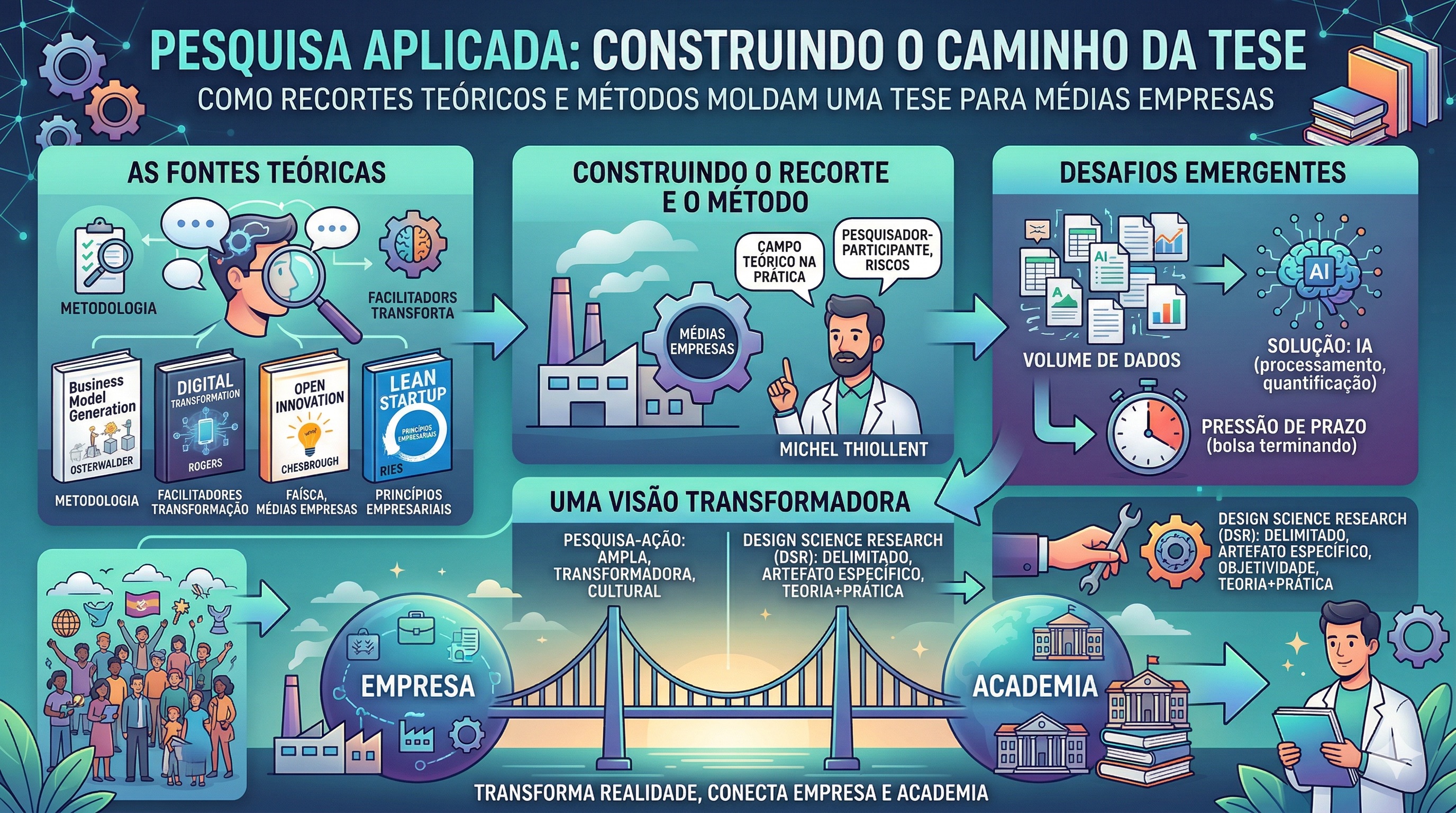
When we write an article, a thesis, or a dissertation, it is fundamental to establish a logic, a line of reasoning. Often, this line stems from our experiences, our readings, and, inevitably, our biases. In my case, some books were decisive for shaping the scope of the thesis.
First, I bring the contributions of Alexander Osterwalder, especially in terms of applied methodology — I read Business Model Generation and incorporated this perspective. I also bring the contributions of David Rogers, who offers a view on digital transformation, focused on facilitators and motivators — what acts as a trigger and as an element that unleashes the process.
Open innovation, in particular, played a significant role. I was introduced to the concept of Open Innovation, its community, and Henry Chesbrough himself a long time ago. I saw it as something intriguing, a spark. Later, upon reading Chesbrough's two books, I understood the connection and the role open innovation plays in the development of innovations. This made a lot of sense, especially for medium-sized companies, which was the scope I intended to investigate. When I read Eric Ries and the concept of Lean Startup, I found principles that could also be applied to the business context. With these readings, I built my vision, my lens, my method.
In the methodological dimension, I read Michel Thiollent and action research, which brought another essential perspective: establishing the theoretical field of research based on practice. That is, I am interested in studying how practice and how application — and, in this sense, action research makes perfect sense. It was a happy discovery. At the same time, as there are many interventions, a lot of data is generated. I then faced a concrete problem: how to deal with this volume of data? What to analyze, what to discard? It was from this need that my dive into artificial intelligence gained strength — as a way to quantify and process this mass of information. Added to this was a practical pressure: if I didn't finish on time, I would be subject to paying for the program again, as my scholarship was about to end. The challenges emerged from this convergence of factors.
I believe that the researcher lives the research. It needs to make sense to them — for their worldview, for their understanding of the world, for what they see and can apply. And what does this imply? That it is necessary to establish a scope, a theoretical lens, and adhere to it. When we move to practice and development via Design Science Research (DSR), we naturally accept that the result may or may not work, and it is precisely the theoretical foundation that supports us on this journey.
I believe this is the transformative point of applied research: it goes beyond mere observation of the phenomenon. In action research, the researcher assumes the role of a participant and, with it, the risks inherent to this position. DSR, in turn, offers a more delimited scope: while action research tends to be broad and transformative, operating on the basis of cultural transformation, DSR focuses on producing something specific — an artifact. This is what gives objectivity to the research and, at the same time, connects theory and practice, transforming the reality of the empirical object investigated. Naturally, this movement brings closer two worlds that need to dialogue more: business and academia.
No comments yet. Be the first!